FIFA LED stadium light smart system supplier in Bolivia


An all-in-one solar street light is usually the better choice when a project requires fast installation, minimal external wiring, a clean appearance and standardized deployment.
A split solar street light is generally more suitable when the project requires independently positioned solar panels, larger battery or photovoltaic capacity, flexible component replacement or highly customized system sizing.
However, system architecture alone does not determine performance. A properly sized all-in-one system can outperform an undersized split system, while a well-engineered split system may be more reliable than an integrated fixture used in unsuitable conditions.
An all-in-one solar street light, also called an integrated solar street light, combines the main system components into one compact fixture. These components normally include:
Solar panel
LED light source
Lithium battery
Solar charge controller
Motion or microwave sensor
Lighting control system
This integrated construction reduces external cabling and simplifies pole-top installation. Modern integrated products frequently use LiFePO4 batteries, MPPT charge controllers and programmable dimming profiles to balance brightness with battery autonomy.
For projects involving residential roads, parks, pathways, campuses, parking areas and remote access roads, a properly designed all-in-one solar street light can provide an efficient and visually clean solution.
It is also important to distinguish traditional integrated lights from newer adjustable designs. In a basic all-in-one fixture, the solar panel and LED module may share the same mounting direction. More advanced systems can allow the solar panel and LED module to be adjusted independently, improving both solar collection and road illumination. HISHINE’s F Series and H Series are designed around this independent adjustment concept.
A split solar street light separates the system into multiple components. The LED luminaire, solar panel, battery and controller may be mounted in different positions and connected by cables.
The solar panel is normally installed on an independent bracket, while the battery may be mounted on the pole, placed inside a protected battery box or installed in another serviceable location.
This modular structure provides greater flexibility in:
Solar panel size
Panel tilt and orientation
Battery capacity
LED fixture selection
Component replacement
System expansion
A split solar street light can therefore be a practical option for wide roads, high poles, demanding lighting schedules, locations with seasonal sunlight variation and projects requiring customized energy storage.
| Factor | All-in-One Solar Street Light | Split Solar Street Light |
|---|---|---|
| System structure | Main components integrated into one fixture | Components installed separately |
| Installation | Faster and more standardized | More installation steps and wiring |
| External cables | Few or none | Normally required |
| Solar panel positioning | Fixed or adjustable, depending on design | Independently adjustable |
| System sizing | Limited by integrated housing dimensions | Highly flexible |
| Maintenance | Fewer external connection points | Individual components are easier to replace |
| Appearance | Compact and modern | More functional and engineering-oriented |
| Shipping and handling | Fewer separate components | More components and packaging |
| Best suited for | Standardized and fast-deployment projects | Customized and high-capacity projects |
| Initial project complexity | Lower | Higher |
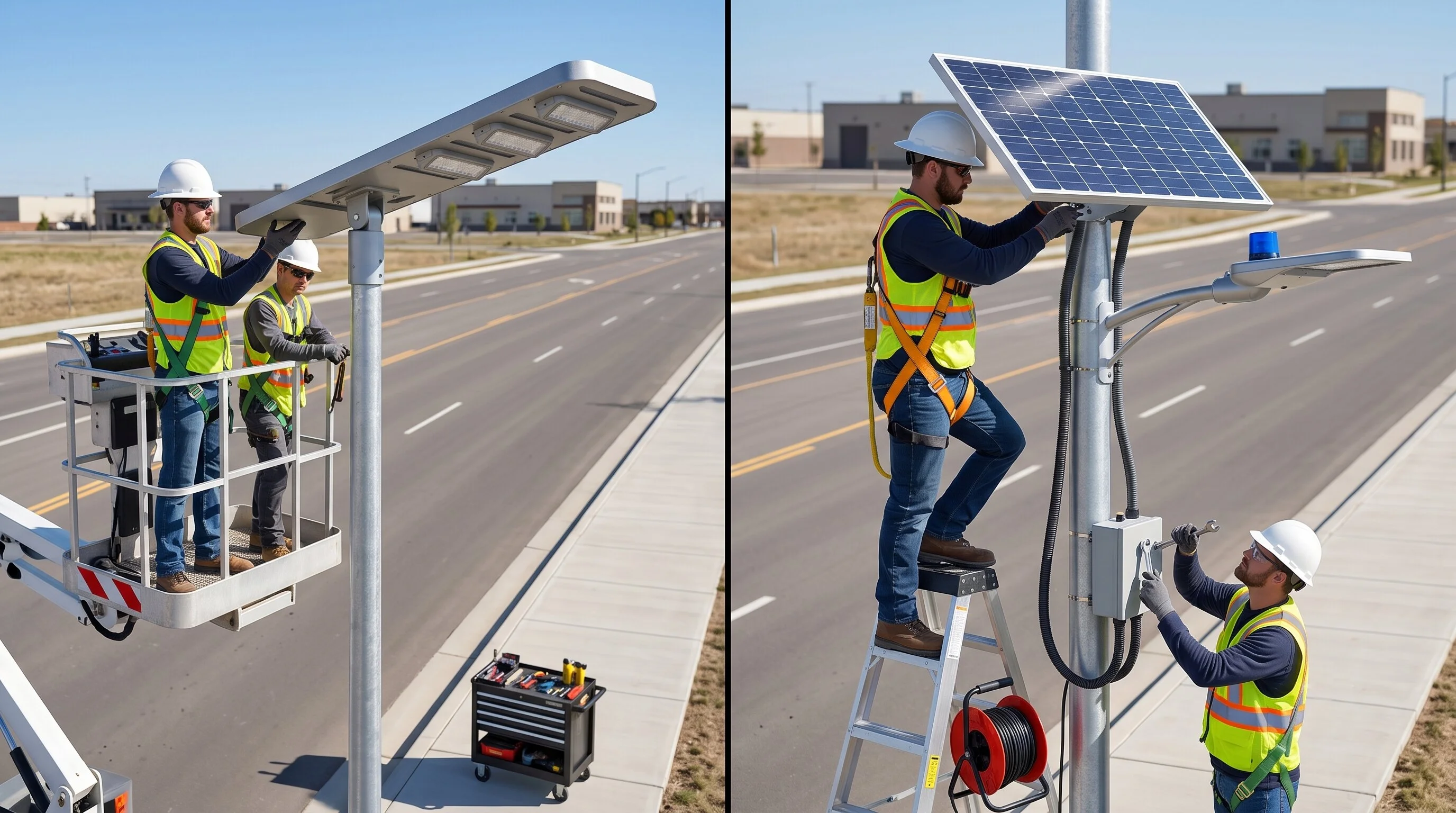
Installation is one of the strongest advantages of an all-in-one system.
Because the solar panel, battery, controller and LED module are already assembled, contractors usually have fewer components to position and connect. This can reduce installation complexity, especially in remote locations where experienced electrical workers or specialized equipment may not be readily available.
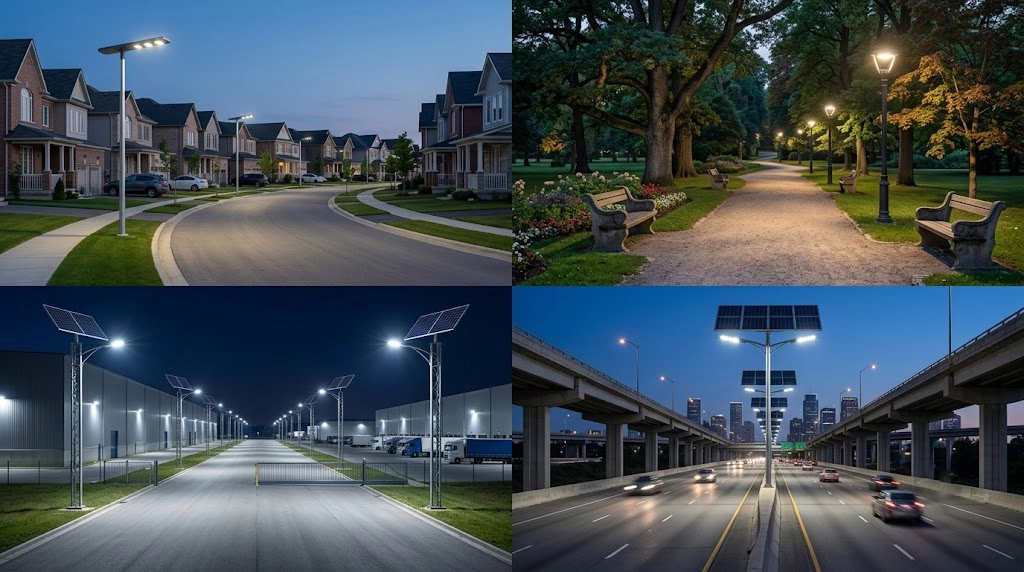
All-in-one systems can be particularly useful for:
Rural roads
Residential communities
Parks and pathways
Temporary access roads
Construction sites
Distributed projects with many small installation locations
Split systems require more planning. Contractors must position the solar panel, install the luminaire, secure the battery, route cables and waterproof the connections.
This additional work is not necessarily a disadvantage. For engineering projects with professional installation teams, it may provide the flexibility needed to optimize each system component.
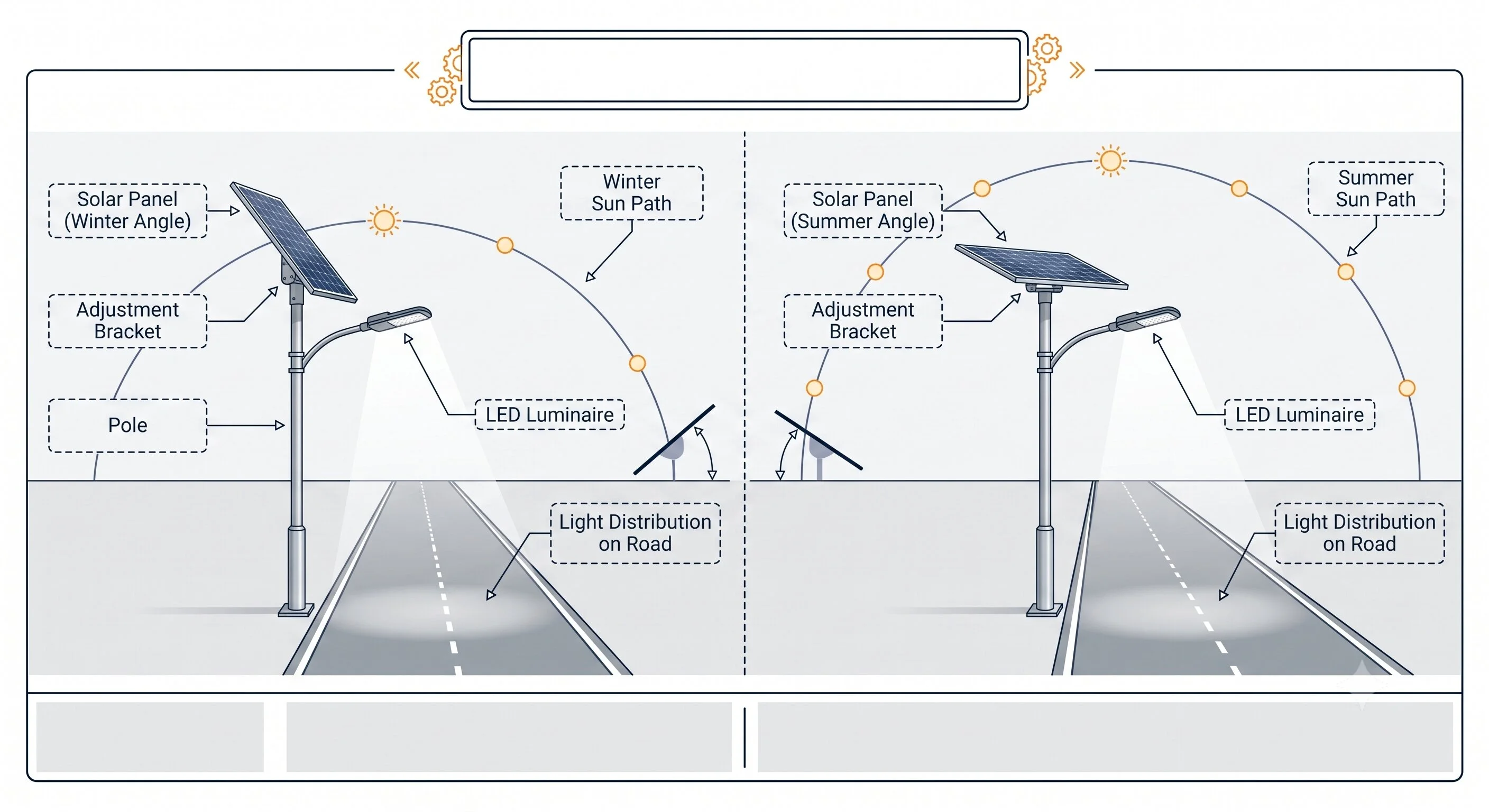
Solar charging performance depends on more than the nominal wattage printed on the panel.
Local solar irradiation, panel orientation, tilt angle, seasonal sun path, shading, dust and temperature all affect the amount of usable energy collected during the day. Panel orientation and inclination are important variables in photovoltaic system design.
Split systems provide a clear advantage when the panel must be positioned independently from the road lighting direction. The luminaire can illuminate the road while the panel faces the most suitable direction for solar collection.
Traditional all-in-one systems may offer less orientation flexibility. However, buyers should not assume that every integrated product has a completely fixed panel. Advanced designs with independently adjustable solar panels and LED modules can reduce this limitation.
For locations with complex road directions, winter shading or seasonal sunlight variation, buyers should request a project-specific solar energy calculation rather than choosing solely by product type.
Battery autonomy describes how long the light can operate when solar charging is limited by rain, clouds, dust or seasonal conditions.
Split systems generally make it easier to install a larger battery because the storage capacity is not restricted by the dimensions of the luminaire housing. This can be useful for projects requiring:
Longer nightly operating hours
Higher maintained output
Several low-sunlight days
Minimal motion-based dimming
Large road or industrial lighting loads
All-in-one systems can still provide reliable autonomy when the solar panel, battery, LED load and dimming program are properly matched.
A professional comparison should therefore evaluate actual energy values, not only advertised lamp wattage. Buyers should ask for:
Solar panel rated power in watts
Battery energy in watt-hours
Expected daily LED energy consumption
Dimming schedule
Charging assumptions
Designed backup period
Minimum operating temperature
For more guidance, review our solar street light lifespan and battery selection resources.
Battery temperature is often overlooked during procurement.
Temperature can significantly affect the performance, safety, degradation and lifecycle cost of an energy-storage system.
In an all-in-one fixture, the battery is normally installed inside the luminaire body near the solar panel and LED system. The enclosure must therefore be designed with appropriate thermal control, component spacing, materials and protection.
A split system allows the battery to be installed separately, potentially in a shaded or more thermally stable location. However, underground or external battery boxes introduce other concerns, including water ingress, condensation, cable protection and accessibility.
Neither structure automatically guarantees longer battery life. The result depends on:
Battery chemistry and cell quality
Charging and discharging profile
Depth of discharge
Ambient temperature
Enclosure design
Waterproofing
Controller protection
Maintenance conditions
All-in-one systems have fewer external cables, boxes and exposed connections. This simplifies routine inspection and reduces the number of separate components installed around the pole.
The trade-off is that service access depends heavily on the fixture design. Buyers should confirm whether the battery, controller, LED module and solar panel can be replaced individually.
Split systems are naturally modular. A damaged solar panel, battery or LED luminaire can normally be replaced without changing the complete system. This can be valuable for municipal projects with established maintenance teams and standardized spare-part inventories.
However, more separate components also mean more brackets, connectors, seals and cables that may require inspection.
The better maintenance solution is therefore the one that matches the owner’s actual service capability.
Solar panels create wind-exposed surface area, whether they are integrated into the luminaire or installed on a separate bracket.
An all-in-one design may produce a compact overall structure, but its complete weight is concentrated near the top of the pole. A split design allows the components to be positioned independently, but the panel bracket and larger surface area require careful structural calculation.
For coastal, typhoon-prone, desert or high-altitude locations, buyers should not select a product based only on appearance. The supplier should evaluate:
Wind speed
Pole height
Panel area
Bracket design
Pole wall thickness
Foundation
Soil conditions
Corrosion protection
The pole and foundation are part of the lighting system, not optional accessories.
All-in-one solar street lights often reduce the number of installation operations and separate accessories. This can lower labor, handling and commissioning complexity.
Split systems may require a higher initial project budget because of additional mounting structures, cabling, battery boxes and installation work.
However, purchase price alone does not determine the more economical solution.
A total-cost comparison should include:
Product price
Freight and packaging
Pole and foundation
Installation labor
Lifting equipment
Replacement batteries
Spare components
Scheduled cleaning
Fault diagnosis
Warranty coverage
Expected operating life
Our solar street light cost guide explains why two products with the same advertised wattage may have very different system costs.
Recommended starting point: All-in-one
These projects usually benefit from simple installation, compact appearance and programmable motion-based lighting.
Recommended starting point: All-in-one
An integrated system reduces external cabling and can simplify deployment across locations with limited installation resources.
Recommended starting point: Evaluate both systems
Do not select by fixture type alone. Road width, pole height, required illuminance, uniformity, operating profile and local solar data should determine the system.
Read our solar street light for highway projects guide before specifying wattage.
Recommended starting point: Split or high-capacity adjustable all-in-one
These applications may require larger energy storage, higher maintained output and customized optics.
Recommended starting point: A maintainable system with strong dust management
Panel cleaning and battery temperature may matter more than whether the system is integrated or split. In locations with frequent dust accumulation, a self-cleaning solar street light may help reduce manual panel-cleaning requirements.
Recommended starting point: Split or independently adjustable all-in-one
Panel orientation, battery sizing and intelligent dimming should be calculated using local solar data.
Before choosing an all-in-one or split system, request the following information from the supplier:
Photometric file and lighting simulation
Road width and pole-height recommendation
Actual luminaire output, not only LED chip efficacy
Solar panel wattage and technology
Battery chemistry, voltage and watt-hours
Charging controller type
Nightly dimming schedule
Designed backup autonomy
Operating and charging temperature ranges
Wind-load and pole requirements
Ingress and corrosion protection
Battery and controller replacement method
Warranty coverage for each component
Similar project references
A responsible manufacturer should be able to explain how the solar panel, battery and lighting load were matched for the project.
Not necessarily. It may reduce installation and accessory costs, but the final project cost depends on product configuration, pole design, battery capacity, shipping, installation and future maintenance.
No. A split system provides more sizing and panel-positioning flexibility, but reliable performance still depends on correct solar and battery calculations.
Yes, provided that the system meets the required lighting levels, uniformity, autonomy, structural and environmental conditions. A photometric simulation and solar-energy calculation should be completed before selection.
All-in-one systems have fewer external components. Split systems make it easier to replace individual components. The better option depends on the maintenance team, spare-parts strategy and fixture design.
Neither structure has an automatic lifespan advantage. Battery quality, temperature, controller design, waterproofing, charging profile, materials and maintenance have a greater influence.
A professional quotation should include luminaire output, solar panel power, battery watt-hours, controller type, dimming schedule, backup autonomy, pole recommendation, warranty and installation requirements.
There is no universal winner in the all-in-one versus split solar street light comparison.
Choose an all-in-one solar street light when the project prioritizes fast installation, compact appearance, fewer external components and standardized deployment.
Choose a split solar street light when the project requires maximum component-sizing flexibility, independent solar panel positioning, larger storage capacity or modular replacement.
For demanding projects, the best solution may also be an advanced all-in-one system with independently adjustable solar and lighting modules.
The correct decision should always begin with road conditions, required lighting performance, local solar data and an energy calculation—not with advertised wattage alone.
HISHINE provides integrated, split, bifacial and commercial solar street light solutions for road, municipal, industrial and off-grid projects. Contact our engineering team with your road dimensions, pole height, location and required operating profile to receive a project-specific recommendation.
Author 2024-08-06
LED technology itself is not automatically harmful to children’s eyes. This guide explains the differences between permanent eye damage, temporary visual discomfort and sleep disruption, while showing...
Author 2026-07-29
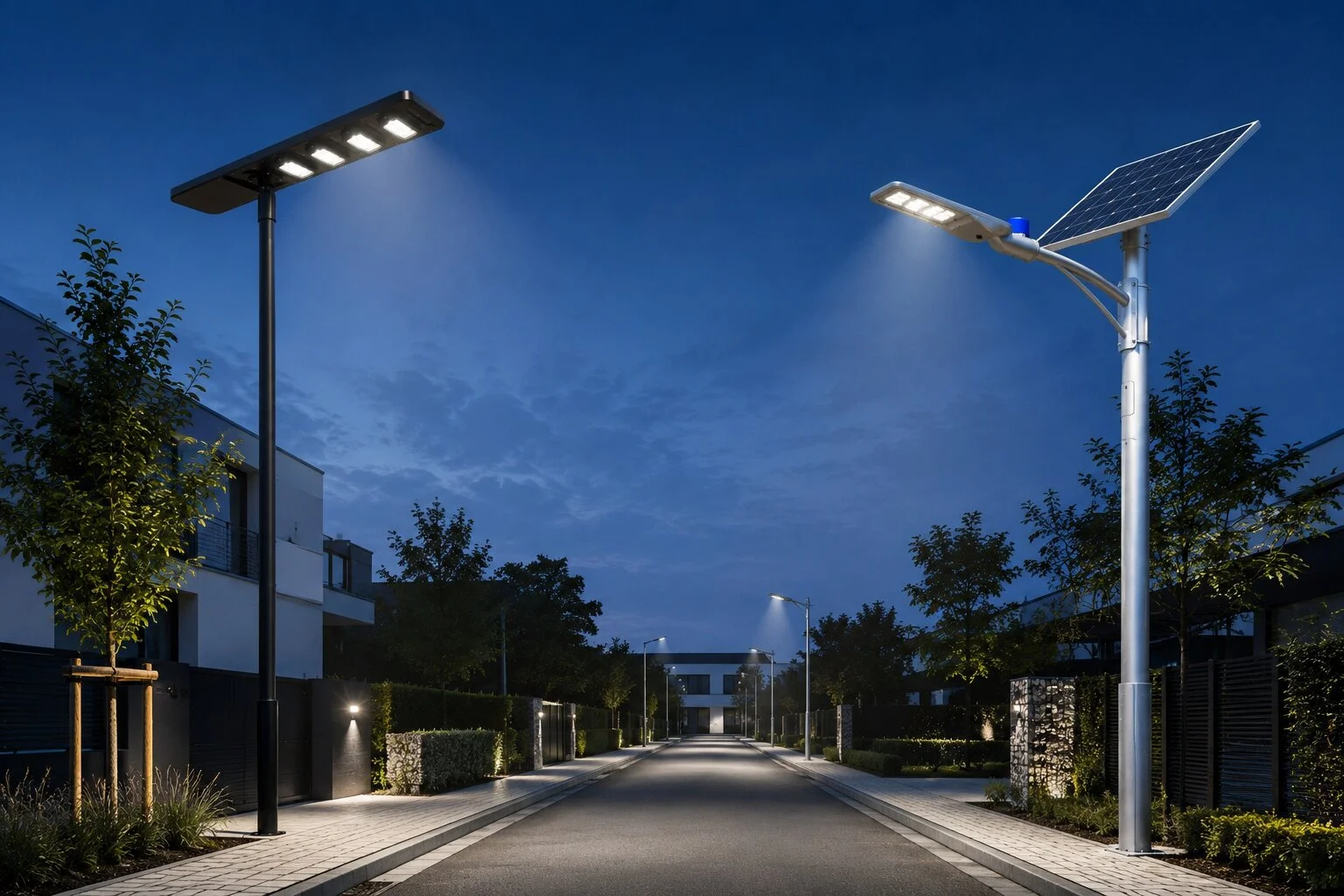
All-in-one and split solar street lights each offer different advantages. This guide compares their system structure, installation, solar panel flexibility, battery capacity, maintenance, cost, and su...